Role of Prediction Events in Football Engagement
Role of Prediction Events in Football Engagement

Every match delivers countless moments that keep football enthusiasts on the edge of their seats, yet predicting those outcomes is a steep challenge. In competitive fantasy leagues and online prediction contests, understanding the true impact of each move can mean the difference between victory and disappointment. By embracing prediction events, fans and analysts can transform regular match data into sharp insights, gaining the upper hand in forecasting strategies and enjoying a deeper appreciation of the game’s underlying patterns.
Table of Contents
- Defining Prediction Events And Their Purpose
- Key Variations In Football Prediction Events
- How Prediction Platforms Score And Rank Users
- Enhancing Fan Engagement Through Predictions
- Risks, Ethics, And User Responsibilities
Key Takeaways
| Point | Details |
|---|---|
| Prediction Events Enhance Understanding | They break down complex match scenarios into measurable components, offering deeper insights into game dynamics. |
| Diverse Event Categories | Different event types, including offensive and defensive actions, provide unique analytical perspectives essential for accurate predictions. |
| User Engagement Through Predictions | Prediction platforms transform fan experiences by enabling active participation and scenario exploration, deepening their appreciation for the game. |
| Ethical Considerations in Predictions | Users must approach predictions critically, recognising their probabilistic nature and maintaining responsible engagement to avoid gambling pitfalls. |
Defining Prediction Events and Their Purpose
In the dynamic world of football analytics, prediction events represent pivotal moments that transform how fans and professionals understand match dynamics. These events are granular, contextually rich interactions that occur during a football match, capturing everything from player movements to tactical shifts. Large Events Models have emerged as groundbreaking frameworks that conceptualise matches as intricate sequences of interconnected events, similar to how language models interpret linguistic patterns.
Prediction events serve multiple critical functions within football engagement. They provide deep analytical insights by breaking down complex match scenarios into measurable, predictable components. Researchers and analysts utilise these events to generate sophisticated forecasting models that go beyond simple win-loss predictions. Event data catalogues systematically track player actions, enabling precise performance analysis and strategic insights that were previously impossible to quantify.
The core purpose of prediction events extends far beyond passive observation. These meticulously tracked interactions help professionals and enthusiasts understand nuanced game dynamics, including:
- Player positioning and movement patterns
- Tactical transitions between defensive and offensive strategies
- Probability of specific match outcomes based on real-time contextual data
- Performance metrics that reveal underlying team and individual player capabilities
By transforming raw match data into intelligent, predictive frameworks, football analytics platforms can offer fans and professionals unprecedented insights into the beautiful game’s intricate mechanics.
Pro tip: When analysing prediction events, focus on contextual patterns rather than isolated statistics to gain more meaningful insights into team and player performance.
Key Variations in Football Prediction Events
Football prediction events encompass a rich tapestry of dynamic interactions that extend far beyond simple match outcomes. Large Event Models have revolutionised our understanding by demonstrating the intricate variations in event types, ranging from player passes and shots to tactical transitions and defensive manoeuvres. These models provide nuanced insights into the probabilistic nature of football events, capturing the complex interplay between individual player actions and overall team strategy.
The diversity of prediction events can be categorised into several fundamental types, each offering unique analytical perspectives. Automatic detection methodologies have revealed significant variations in event classification, highlighting the challenges of accurately capturing and predicting different match interactions. The primary variations include:
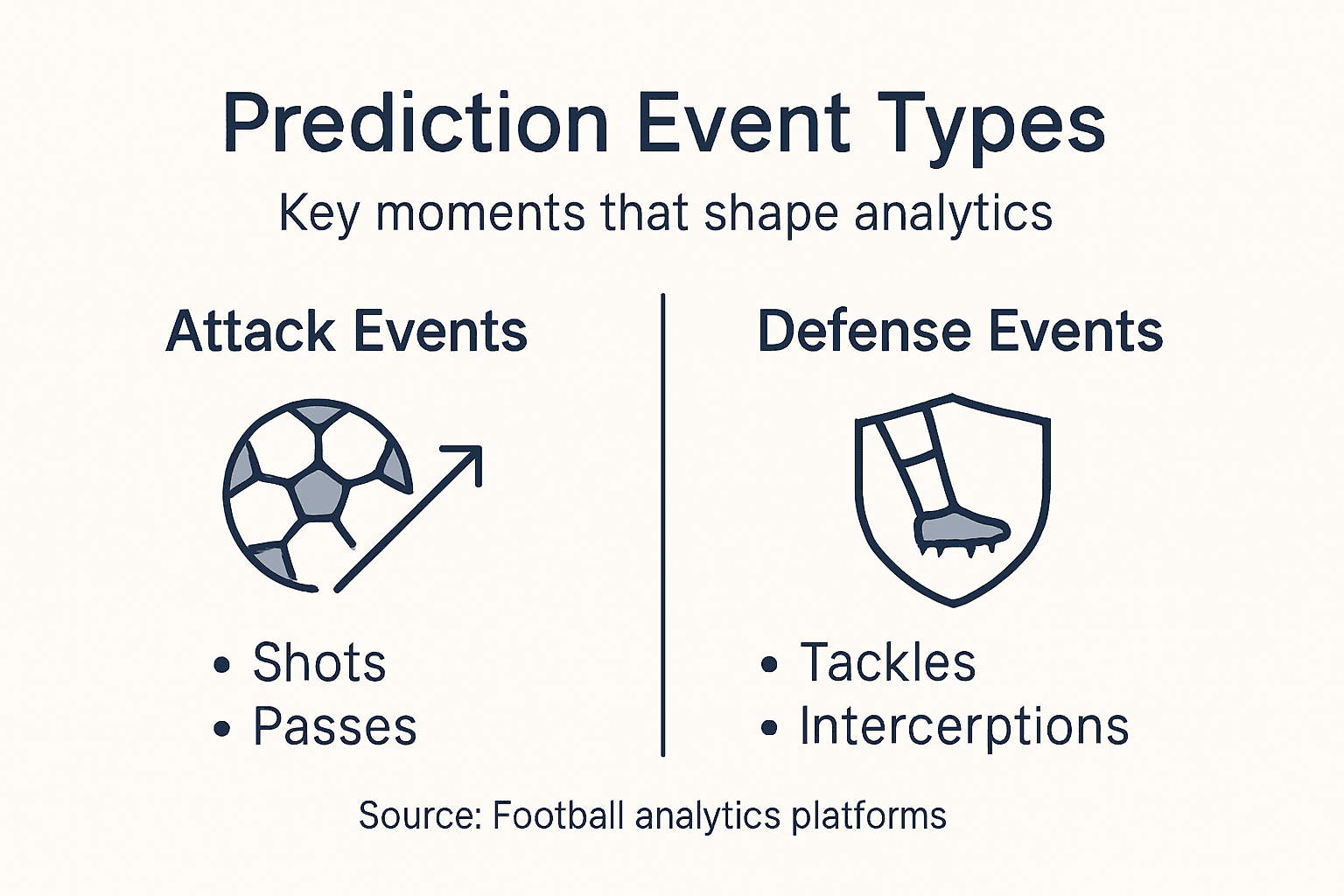
- Offensive Events: Shots, passes, crosses, and goal attempts
- Defensive Events: Tackles, interceptions, blocks, and clearances
- Transitional Events: Player movements, positional shifts, and tactical changes
- Physical Events: Player interactions, collisions, and stamina-related metrics
Each event type presents unique challenges in prediction, requiring sophisticated analytical frameworks that can adapt to the nuanced dynamics of football. By understanding these variations, analysts and enthusiasts can develop more sophisticated predictive models that capture the intricate nature of the sport.
Here’s a summary of how major prediction event categories impact football analysis:
| Event Category | Example Insights Provided | Typical Data Captured |
|---|---|---|
| Offensive Events | Reveal attacking efficiency | Pass accuracy, shot locations |
| Defensive Events | Strengths in regaining control | Tackle success, interceptions |
| Transitional Events | Tactical responsiveness | Player movement tracking |
| Physical Events | Assess stamina and duels | Distance covered, collisions |
Pro tip: Focus on contextual patterns across different event types rather than isolating individual metrics to develop more comprehensive football prediction strategies.
How Prediction Platforms Score and Rank Users
Prediction platforms employ sophisticated mathematical models to evaluate and rank user performance, transforming football forecasting into a dynamic competitive experience. Neural network forecasting techniques have revolutionised the scoring mechanisms, enabling platforms to develop intricate ranking systems that assess prediction accuracy with unprecedented precision. These systems go beyond simple win-loss calculations, considering nuanced factors such as prediction confidence, match complexity, and statistical probability.
The core scoring methodology typically involves multiple sophisticated parameters. Classifier optimization strategies reveal that ranking systems are designed to reward users who demonstrate consistent and intelligent prediction capabilities. The primary scoring components generally include:
- Accuracy Percentage: Percentage of correct match predictions
- Confidence Levels: User’s self-assessed prediction certainty
- Complexity Multipliers: Additional points for predicting challenging or high-stakes matches
- Consistency Metrics: Long-term performance evaluation
- Predictive Precision: Statistical measurement of prediction quality
These multifaceted scoring mechanisms incentivise users to develop more sophisticated prediction strategies, transforming casual football forecasting into an intellectually engaging challenge. By creating transparent and dynamic ranking systems, prediction platforms maintain user engagement and continuously improve the overall quality of match predictions.

Pro tip: Develop a systematic approach to predictions by analysing historical data, team statistics, and current form to improve your ranking performance.
Enhancing Fan Engagement Through Predictions
Modern football prediction platforms have transformed passive spectating into an interactive, data-driven experience that deeply engages fans. Predictive analytics metrics provide unprecedented insights into match dynamics, allowing supporters to understand the nuanced mechanics behind team performances beyond traditional viewing experiences. These sophisticated tools translate complex statistical information into accessible, compelling narratives that capture fans’ imagination and intellectual curiosity.
The interactive nature of prediction platforms creates multiple engagement touchpoints. Large Events Model frameworks enable fans to explore multiple match scenarios, effectively turning football watching into an immersive, participatory experience. This approach offers fans several key engagement opportunities:
- Scenario Exploration: Simulating potential match outcomes
- Statistical Deep Dive: Understanding underlying performance metrics
- Competitive Prediction: Challenging friends and global communities
- Personalised Insights: Tailoring match analysis to individual interests
- Real-time Learning: Gaining deeper tactical understanding
By democratising complex football analytics, these platforms convert statistical complexity into an accessible, exciting form of entertainment. Fans transition from passive viewers to active participants, developing a more nuanced appreciation of the sport’s strategic intricacies.
Pro tip: Experiment with different prediction strategies and track your performance to develop a more sophisticated understanding of football match dynamics.
Risks, Ethics, and User Responsibilities
Football prediction platforms operate within a complex ethical landscape that demands careful navigation from both users and organisers. Event data analysis risks reveal critical challenges in maintaining data integrity and transparency, highlighting the importance of understanding the probabilistic nature of predictive models. Users must approach these platforms with a critical mindset, recognising that predictions are sophisticated estimates rather than absolute guarantees.
Responsible prediction engagement requires a nuanced understanding of potential ethical pitfalls. The primary responsibilities for users include:
- Critical Analysis: Questioning prediction methodologies
- Data Literacy: Understanding statistical limitations
- Responsible Betting: Avoiding compulsive gambling behaviours
- Emotional Detachment: Preventing personal investment in predictions
- Continuous Learning: Recognising model imperfections
The ethical framework surrounding football prediction platforms emphasises transparency, user education, and responsible engagement. By establishing clear guidelines and promoting informed participation, these platforms can mitigate potential risks while maintaining the excitement and intellectual challenge of predictive analytics.
The table below highlights common ethical challenges and ways users can remain responsible on prediction platforms:
| Ethical Challenge | User Responsibility | Best Practice |
|---|---|---|
| Data Misinterpretation | Seek context before acting | Read methodology details |
| Overconfidence in Outcomes | Remain aware of prediction limitations | Treat results as estimations |
| Emotional Bias | Avoid personal attachments influencing bets | Prioritise data over fan loyalty |
| Gambling Temptation | Set strict boundaries on participation | Use budgeting and self-limits |
Pro tip: Always treat predictions as probabilistic insights, not guaranteed outcomes, and maintain a balanced perspective when engaging with football forecasting platforms.
Elevate Your Football Prediction Experience with Precise Event Insights
Understanding the intricate role of prediction events is key to mastering football engagement. The article highlights challenges like capturing dynamic player movements, tactical transitions, and performance metrics within real-time match scenarios. Fans and analysts alike seek a platform that transforms complex event data into actionable, predictive insights while allowing them to compete and connect with a community that shares their passion.
That is exactly where DB.Football steps in. Our platform offers a state-of-the-art prediction environment where you can predict match outcomes and individual events with a smart scoring system that rewards accuracy on results, exact scores, and key match moments. Whether you are analysing offensive plays or defensive manoeuvres, our real-time updates and leaderboards empower you to develop sophisticated strategies and prove your expertise among friends and global fans.
Take control of your football knowledge and immerse yourself in the excitement of prediction competitions today.
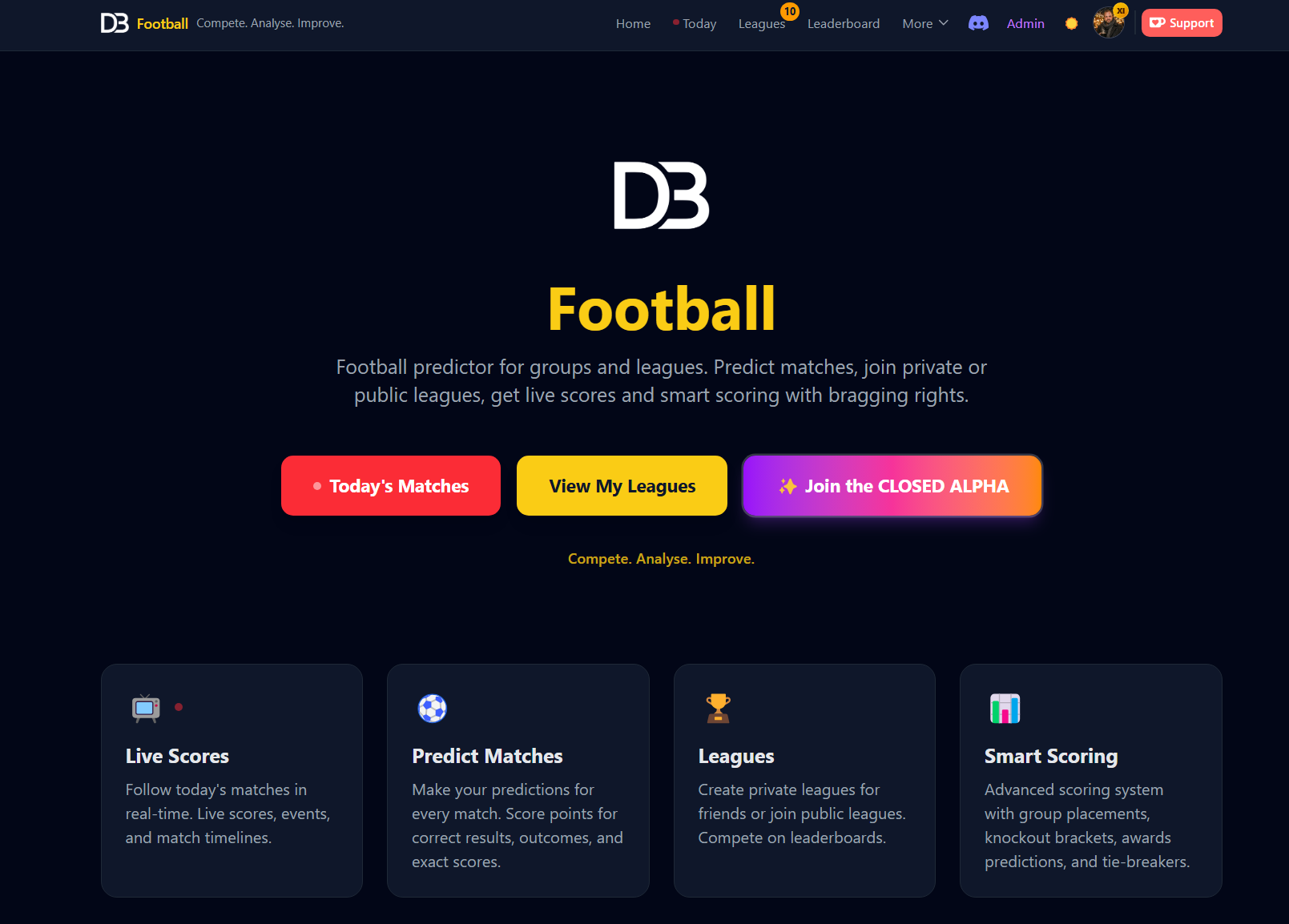
Join DB.Football now to explore comprehensive match timelines, participate in competitive leagues, and harness advanced event analytics that transform your predictions into winning performances. Don’t just watch football. Predict, compete and dominate with DB.Football.
Frequently Asked Questions
What are prediction events in football?
Prediction events are key moments and interactions during a football match that provide insights into the match dynamics. They capture various actions, such as player movements, tactical shifts, and match outcomes, allowing analysts to break down complex scenarios into measurable components.
How do prediction events enhance football analytics?
Prediction events enhance football analytics by offering detailed insights into player performance and team strategies. By analysing these events, researchers can build sophisticated forecasting models that go beyond basic win-loss predictions, capturing the nuances of gameplay.
What types of prediction events are commonly tracked in football?
Common types of prediction events include offensive events (shots, passes), defensive events (tackles, interceptions), transitional events (positional shifts), and physical events (collisions, stamina metrics). Each type provides unique analytical perspectives to enhance match understanding.
How do prediction platforms evaluate user performance?
Prediction platforms use advanced mathematical models to score and rank user predictions based on accuracy, confidence levels, complexity of predictions, consistency over time, and precision of outcomes. This encourages users to refine their predictive strategies and engages them more deeply in the forecasting process.